

Japanese Patterns: Tradition and Contemporary Design
Traditional Japanese patterns hold an important place in the art and craftsmanship of Japan. Found on kimono, textiles, lacquerware, ceramics and everyday objects, they form a rich and diverse visual vocabulary.
Geometric, botanical or inspired by nature, these patterns have evolved over the centuries alongside techniques and their uses. Some have become instantly recognizable, such as Asanoha, Seigaiha and Kumo, the Japanese word for clouds.
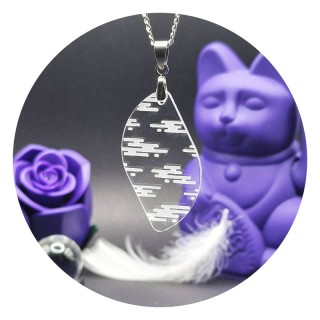
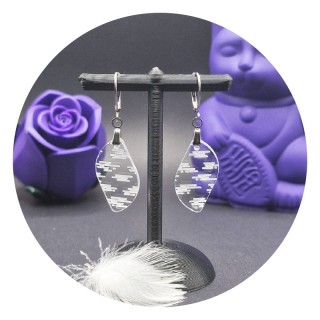
This world of graphic forms is one of the sources of inspiration behind my acrylic jewelry.
The Art of Traditional Japanese Patterns
The history of Japanese patterns is ancient. Some can be traced back to early periods of Japanese history, while others were introduced from abroad and gradually adapted and transformed in Japan. Over the centuries, they became part of a rich decorative tradition, appearing on everything from kimono to everyday and ornamental objects.
These patterns are not always simply decorative. Some evoke nature, the changing seasons or auspicious ideas, giving their use a particular meaning or intention.
But beyond their history and symbolism, what fascinates me most is their graphic strength: a few repeated lines, a play of symmetry or a stylized shape can be enough to create a pattern that is immediately recognizable.
Asanoha: The Hemp Leaf Pattern
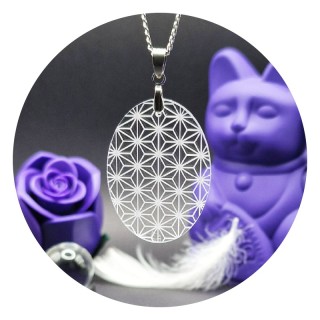
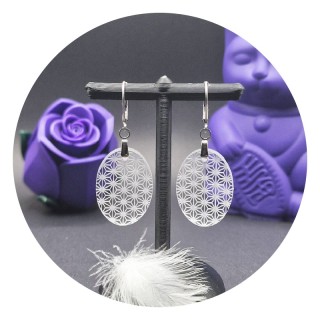
Asanoha (麻の葉) literally means “hemp leaf.” The pattern represents the leaves of the hemp plant through a geometric arrangement of intersecting lines and repeating shapes.
Because hemp was known for its vigorous and rapid growth, Asanoha became associated with strength and healthy growth and was traditionally used, among other things, on children's clothing.
But it is also the geometric structure of Asanoha that makes it so striking. A botanical form becomes a regular network of lines and triangles that can be repeated almost endlessly.
This combination of nature and geometry is one of the aspects that drew me to this pattern.
Seigaiha: The Wave Pattern
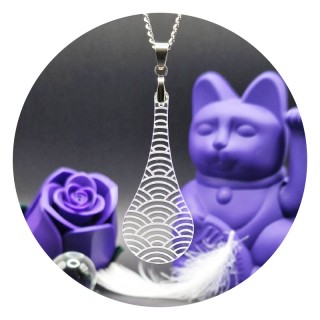
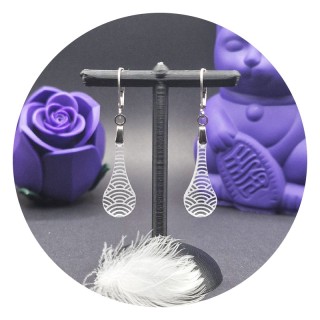
Seigaiha (青海波) is a traditional Japanese pattern made of stylized waves, represented by repeated concentric arcs that flow into one another.
Its name is associated with an ancient court dance performed as part of gagaku, in which the dancers wore costumes decorated with this pattern. Seigaiha later became widely used throughout Japanese decorative arts.
The regular repetition of the waves creates a strong sense of continuous movement. The flowing curves naturally evoke the sea and the horizon.
The endless succession of waves is also associated with the idea of a peaceful life and lasting happiness.
I particularly love the way Seigaiha creates a sense of movement from an incredibly simple form.
Kumo: Japanese Cloud Patterns
Kumo (雲) means “cloud” in Japanese. Cloud patterns belong to the rich repertoire of nature-inspired designs found throughout Japanese art and craftsmanship.
Clouds have been represented in many different ways depending on the period and artistic style: rounded shapes, swirling forms, stylized lines or repeating compositions. Like many Japanese patterns inspired by nature, they can appear on their own or combined with other elements.
What draws me to Kumo patterns is their ability to suggest something light and constantly moving while still being transformed into highly graphic shapes.
Clouds become a play of curves, repetition and volume, making them particularly well suited to reinterpretation in acrylic.
Jewelry Inspired by Japanese Patterns
Through this collection, I bring together the aesthetic of traditional Japanese patterns and contemporary French design.
Each piece is inspired by an existing pattern — Asanoha, Seigaiha or Kumo — but transforms it into an original acrylic jewelry design.
Here, tradition becomes a starting point: an ancient pattern, a new material and a different way of seeing and wearing it.
These creations are an invitation to discover the richness of Japanese patterns from a different perspective, through a contemporary and handcrafted interpretation.